Spanish Trains: Which Railway Company Should You Choose?
Renfe, Iryo, Ouigo España, and Avlo all operate trains in Spain, but what are the differences between these train operators, and which Spanish railway company is best?
Different Spanish railway companies explained
Unlike some other countries in Europe, where there is only one national railway company, Spain has multiple train operators.
On some Spanish routes, you can choose between trains from as many as four different operators, while on other railway lines there is no competition at all.
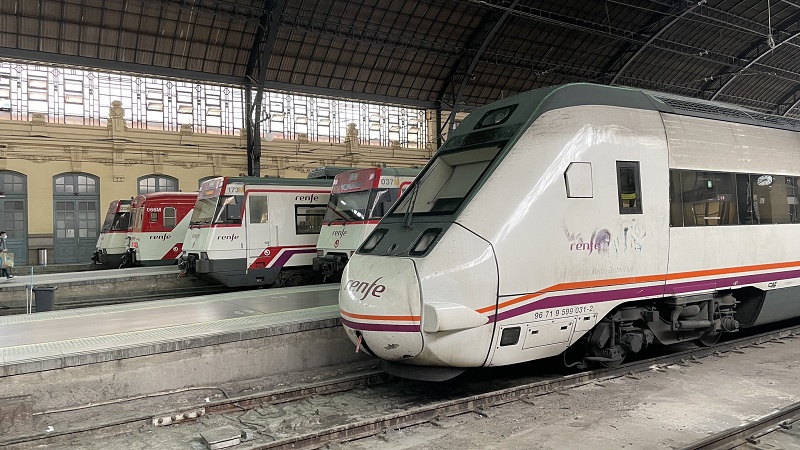
Spanish trains at Valencia Nord. ©AndyBTravels
Renfe, the Spanish national operator
Renfe is the national railway company of Spain and operates the majority of trains across the country.
A wide variety of train types are operated by Renfe, including:
- AVE (Renfe’s premium high-speed service)
- Euromed (the name of Renfe’s high-speed train service between Barcelona, Valencia, and Alicante)
- Alvia (second-tier high-speed trains)
- Avant (high-speed services that operate on short and mid-distance routes)
- InterCity (standard long-distance trains)
- Media Distancia (mid-distance services)
- Regional trains
- Commuter trains (called Cercanías in Madrid and most of the country, but Rodalies in Barcelona)
Renfe also operates trains on the narrow-gauge railway network in northern Spain, which was previously known as FEVE.
With the exception of Avant services (which are second class only), all Renfe high-speed trains offer first and second class seating, with many AVE and Euromed services also offering a “Premium” first class fare that includes lounge access and a complimentary at-seat meal being served.
Intercity and Media Distancia trains may be either second class only or offer both first and second class, depending on the service, while regional and local trains are second class only.

Renfe Alvia service from Bilbao to Barcelona. ©AndyBTravels
Avlo
Renfe also operates a low-cost high-speed rail service called Avlo, which runs on only a few of the main high-speed corridors.
Avlo generally offers lower fares, but has stricter luggage rules than standard high-speed trains operated by Renfe.
Avlo high-speed trains are second class only.
Ouigo España
Owned by SNCF, the French national railway company, Ouigo España runs low-cost high-speed train services in Spain as an open-access operator.
Like Avlo, Ouigo España has stricter luggage rules and operates only on some of the main high-speed railway lines in Spain.
However, unlike Avlo, there is also first class available on Ouigo España trains.

Avlo high-speed train (left), Renfe trains (middle pair), and Ouigo España high-speed train (right) at Alicante. ©AndyBTravels
Iryo
Iryo is a private high-speed operator in Spain that is partly owned by Trenitalia, Italy’s national railway company.
The high-speed train services operated by Iryo are broadly comparable in quality to Renfe’s premium AVE services, and they run on Spain’s most important high-speed rail lines.
On Iryo trains, you can find both first and second class, as well as a Premium first class option that includes a complimentary meal and drink.

Iryo train just outside Madrid Atocha. ©AndyBTravels
Dining cars
On Renfe’s AVE and Euromed high-speed services, there is a café-bar coach where you can buy drinks and snacks.
You will also find a café-bar coach on most Renfe Alvia, Avant and InterCity trains, although whether it is open or not depends on the route.
Iryo and Ouigo España high-speed trains also have a café-bar coach, although you will not find one on Avlo trains.
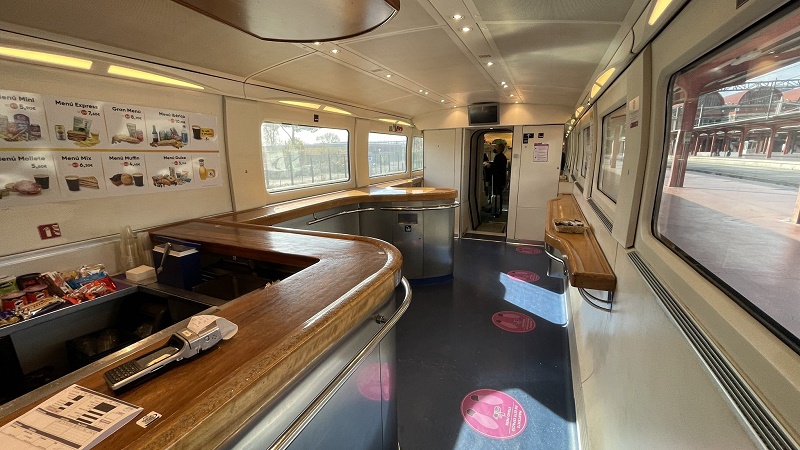
Café-bar coach on a Renfe high-speed train. ©AndyBTravels
Searching and booking Spanish train tickets
With four different railway companies in Spain, it can be tricky to choose the best train for your journey.
However, there is no need to visit each operator’s website individually and make a manual comparison.
By using the reliable booking website Omio, you can compare trains from all these Spanish railway companies in a single search and choose the best option based on price, departure time, or any other parameter.
Omio clearly shows what facilities you can expect on board each train, as well as what is included in your ticket, such as whether the fare you have selected is refundable or changeable.
Use the journey planner below to find the best train for the Spanish route you want to travel on.
Don’t forget to read my page with Spanish train ticket booking tips to secure the best deal!
Conclusion
There are four different railway companies in Spain, with the national railway company, Renfe, operating the majority of trains across the country, ranging from high-speed services to commuter trains.
Renfe also has a low-cost high-speed subsidiary called Avlo, which competes with another low-cost high-speed operator, Ouigo España.
Finally, there is Iryo, a private high-speed operator in Spain that may also be worth considering.
Which railway company is best for you depends on the route you plan to travel.
While on some routes all four companies operate services, there are many others with no competition, where you will find only Renfe trains.
Even where there is competition, the best choice is often a matter of personal preference.
Ticket prices can vary significantly, and while some travellers may prioritise the operator with the lowest fare, others may prefer the highest level of comfort and service.