
How to Book Your Spanish Train Ticket Online: Tips and Tricks
Booking a Spanish train ticket online is straightforward, and with these tips and tricks you can secure the lowest fares and best deals.
Train travel in Spain: the basics
Spain has a high-quality railway network connecting almost all major cities and tourist destinations by train.
In fact, Spain has the largest high-speed railway network in Europe, and travelling on these trains is even faster from city centre to city centre than flying.
The national railway company, Renfe, operates the majority of services across the country.
However, on the Spanish high-speed network, Renfe faces competition from private operators, namely Iryo and the low-cost company Ouigo España.
Renfe also operates its own low-cost high-speed train service called Avlo, which is available on certain routes across Spain.

A Renfe ‘Alvia’ train service from Bilbao to Barcelona. ©AndyBTravels
Where to book tickets
Of all the tips and tricks to secure the best deal and cheapest ticket for your Spanish train travel, comparing fares between different operators is the most important.
Rather than visiting the individual websites of each railway company, you can use the reliable booking platform Omio to compare train departure times and fares from all operators in a single search.
Use the search tool below to find the best train connection between the Spanish cities you plan to visit!
When to book your Spanish train ticket
Almost all train services in Spain – with the exception of local commuter services and some regional “media distancia” trains – require a compulsory seat reservation, which will be automatically included in your ticket.
This means that trains in Spain can sell out, and on popular routes they frequently do.
It’s also important to know that all long-distance and high-speed trains in Spain have variable pricing based on demand, much like flight tickets.
This means that if you are travelling on a popular day or during peak season, you will generally find the cheapest tickets by booking as far in advance as possible.
This is particularly important when travelling during the high summer season or around national or local holidays, such as Easter or the ‘ferias’ in certain Spanish cities, when securing your ticket well in advance is essential.
The same applies to routes with a relatively limited train schedule.
On a route like Madrid to Seville, with dozens of daily departures, seats are plentiful, whereas the single daily train linking Madrid with Algeciras is far more likely to sell out if you leave your ticket purchase until the last minute.

Renfe high-speed trains at the station of Madrid Atocha. ©AndyBTravels
Ticket window
One thing to note about Spanish train tickets is that sometimes you cannot book them too far in advance, as the schedules have not yet been finalised and tickets have not yet gone on sale.
Unfortunately, Spanish trains – particularly those operated by the national railway company Renfe – have a somewhat erratic booking horizon.
On some routes, trains are typically loaded only 30 days in advance, while on others tickets may be available many months ahead.
As a rule of thumb, if no trains appear for the route and date you are searching, check the dates immediately before and after.
If none of these dates show availability either, it is likely that tickets have simply not yet been loaded into the system and cannot be booked – not by you, and not by anyone else – so there is no need to worry.
Discount deals
Competition among rival operators means that train tickets in Spain can be surprisingly affordable.
During the low season – particularly in the middle of winter – trains are often less busy, and prices frequently drop.
It is not uncommon for Spanish train operators to offer special discount deals or sales during these periods.
In fact, at such times, it may be possible to get the best deal by booking your ticket only weeks before travel, rather than many months in advance.

Avlo (left), Renfe (two middle ones), and Ouigo (right) trains at the station of Alicante ©AndyBTravels
Travel days
There are a few more Spanish train ticket tips to keep in mind if you want to get the best possible deal.
Some days of the week are more popular than others for travel, both among business and leisure passengers.
On the busy Barcelona-Madrid train route, Sundays, Mondays, and Fridays are typically the most popular, as people plan their trips around the working week or weekend breaks.
Among business travellers in particular, early morning trains and those immediately after office hours are always the busiest and therefore the most expensive, while trains in the middle of the day can be significantly cheaper.
Use this knowledge to your advantage!
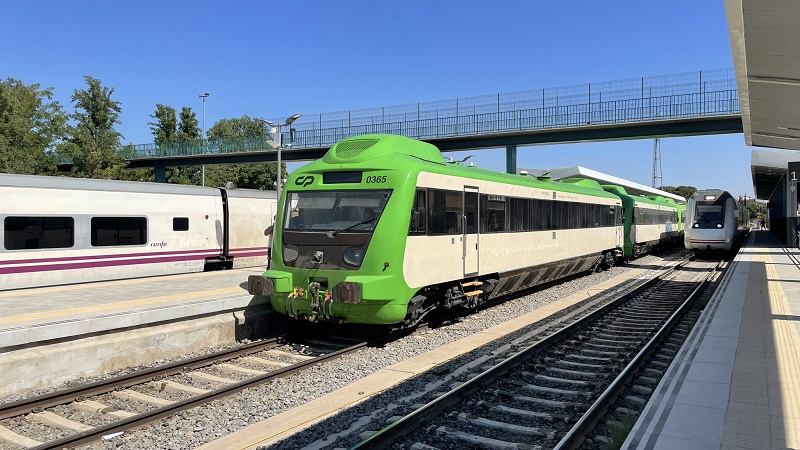
Trains at the station of Badajoz. ©AndyBTravels
A rail pass for Spain, a good idea?
There are some Spanish rail passes available, such as Interrail or Eurail.
However, if you are travelling solely within Spain, these passes are often not good value, as point-to-point tickets are usually cheaper, especially if your itinerary is fixed and you can book in advance.
In addition, rail passes can be cumbersome to use in Spain, as you still need to book separate seat reservations for passholders.
That said, if you plan to visit several other European countries in addition to Spain, or if you want flexibility in when and where you travel without committing to specific travel times or dates in advance, a rail pass can be very worthwhile.
Conclusion
With the Spanish train ticket tips above, you will be able to secure the best deals for your travels across the country.
To get the best prices, always compare fares between different train operators.
Also, be aware of which days of the week are generally cheaper to travel, when it is best to book your tickets well in advance, and when it might be more worthwhile to wait a little.