
Madrid to Barcelona by High-Speed Train
Frequent high-speed train services connect Madrid with Barcelona, providing a convenient way to travel from the Spanish capital to the Catalan coast.
The Madrid-Barcelona high-speed railway line
Completed in 2008, the Madrid–Barcelona high-speed rail line is 621 kilometres (385.9 miles) long and allows trains to reach maximum speeds of up to 350 kilometres per hour (217.5 mph).
Non-stop trains can complete the journey between Madrid and Barcelona in just 2.5 hours.
Some high-speed trains also stop at intermediate stations on the line, with Zaragoza being the most important.
The opening of the Madrid-Barcelona high-speed line has led to a major shift from road and air transport to rail.
The famous Madrid-Barcelona “Puente Aéreo” route, which had 55 daily flights in 2012, now operates just around 90 flights a week.
It clearly shows that the high-speed train is a more attractive (and even a faster!) option than flying between Madrid and Barcelona, allowing passengers to travel directly from city centre to city centre, without any of the hassle of getting to out-of-town airports and wasting time there with check-in cutoffs and baggage reclaim.
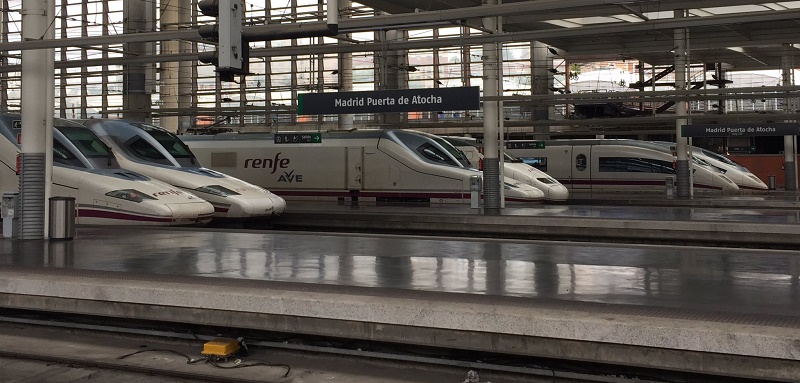
Renfe high-speed trains at the station of Madrid Atocha. ©AndyBTravels
Booking your high-speed train ticket
There are multiple operators running high-speed trains between Madrid and Barcelona, which is good news for passengers, as competition means fares can be surprisingly affordable.
Renfe is Spain’s national railway company and operates its premium AVE high-speed trains on the Madrid-Barcelona route.
Competing with Renfe are the private high-speed operator Iryo and the low-cost high-speed operator Ouigo España.
If you want to compare prices between all three operators and find the best connection for your travel date, you can use the search tool below from Omio, a well-regarded online booking platform.
Omio allows you to book high-speed trains with Renfe, Iryo, and Ouigo, accepts foreign debit and credit cards, and clearly displays fare conditions, such as whether a ticket is changeable or refundable and what is included in the ticket price.
Travel tips
If you are planning to travel by high-speed train from Madrid to Barcelona – or vice versa – consider the following travel tips:
- Spanish high-speed train tickets can sell out, so it is generally best to book as far in advance as possible, particularly during the peak summer season or around national holidays.
- The Madrid-Barcelona route is popular with both business travellers and tourists, meaning that Sundays, Mondays, and Fridays are typically the busiest days, with the highest fares, while Wednesdays and Saturdays are often cheaper.
- You need to go through security before boarding a high-speed train in Spain, so make sure you arrive at the station at least 30 to 40 minutes before departure. As both Madrid Atocha and Barcelona Sants – the stations used by high-speed trains – are quite large and can be confusing, it is especially advisable to arrive early if you are new to train travel in Spain.
- Feel free to take snacks and drinks along with you on the train. Even though there is a security check for high-speed trains and your luggage will be scanned, there are no limits for taking any liquids on board. Alternatively, visit the dining car you will find on Spanish high-speed trains and buy snacks and drinks there!
- Ouigo high-speed trains have low-cost airline-style baggage limits, so check conditions carefully if you travel with them.

Iryo train just outside Madrid Atocha. ©AndyBTravels
Conclusion
With affordable fares and a travel time that is even faster than flying, the high-speed train is the best way to travel between Madrid and Barcelona.
On this route, you can choose between services operated by Spain’s national rail operator Renfe, the private high-speed operator Iryo, and the low-cost high-speed company Ouigo.