Italian Trains: What is the Difference Between Italo and Trenitalia?
If you’re planning to travel by train in Italy, it helps to understand the difference between the country’s two main rail operators, Italo and Trenitalia.
In this guide, I’ll explain everything you need to know about Italo and Trenitalia, outline their main differences and similarities, and share some handy tips for your Italian rail adventure.
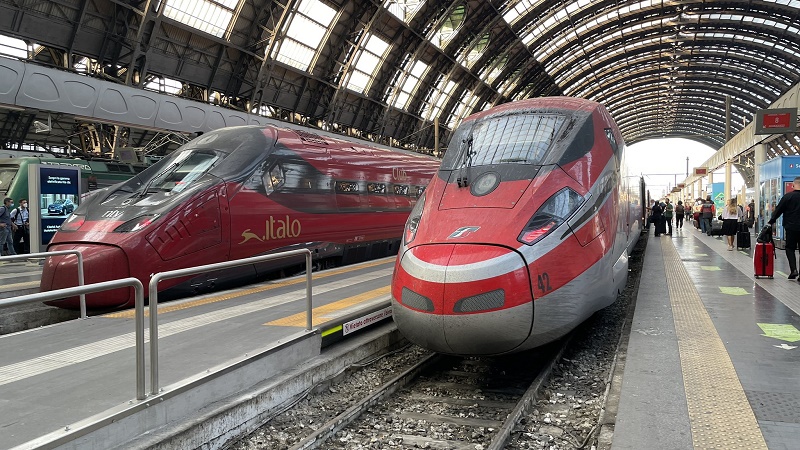
Italo and Trenitalia high-speed trains at Milano Centrale, the central railway station of Milan. ©AndyBTravels
Trains in Italy
There are two railway companies in Italy that operate long-distance trains:
- Trenitalia
- Italo
Trenitalia is Italy’s national railway company and operates several types of long-distance train services, including high-speed trains under the Frecciarossa brand, daytime InterCity services, and InterCity Notte sleeper trains.
In addition to these long-distance services, Trenitalia also runs regional and commuter trains across most parts of the country.
Italo, on the other hand, is a private railway company that exclusively operates high-speed trains.
Trenitalia and Italo compete fiercely on the Italian high-speed rail network, especially on the main high-speed line linking Milan and other northern Italian cities such as Venice and Turin with Bologna, Florence, Rome, and Naples.
You can easily buy Italian train tickets through the reliable booking website Omio, which sells tickets for both Italo and Trenitalia trains.
Use the search tool below to compare prices and departure times for Trenitalia and Italo on your chosen route.
Similarities between Italo and Trenitalia
Although Italo and Trenitalia are two completely different operators, their high-speed trains are broadly comparable when it comes to passenger comfort and reliability.
Both Italo services and Trenitalia’s high-speed Frecciarossa trains are modern, offer good comfort across all travel classes, and have a solid reputation for punctuality.
Unless you have a clear preference for one operator, most tourists will not notice a significant difference between the two.
In second class, the seating layout is always 2+2, whether you choose Italo (where second class is called ‘Smart’) or Trenitalia’s Frecciarossa trains (where second class is known as ‘Standard’, and there is also a premium second class known simply as ‘Premium’, which includes a welcome drink and guarantees a leather seat rather than a cloth one).
Also in first class, Italo and Trenitalia are comparable, with both ‘Prima’ (the first class product on Italo trains) and ‘Business’ (the first class product on Trenitalia trains) being similar in the 2+1 seating layout of the coach and the complimentary snacks and drinks provided.
My main tip for travellers to Italy is therefore to prioritise price and departure time when choosing a train, regardless of whether it is operated by Italo or Trenitalia.
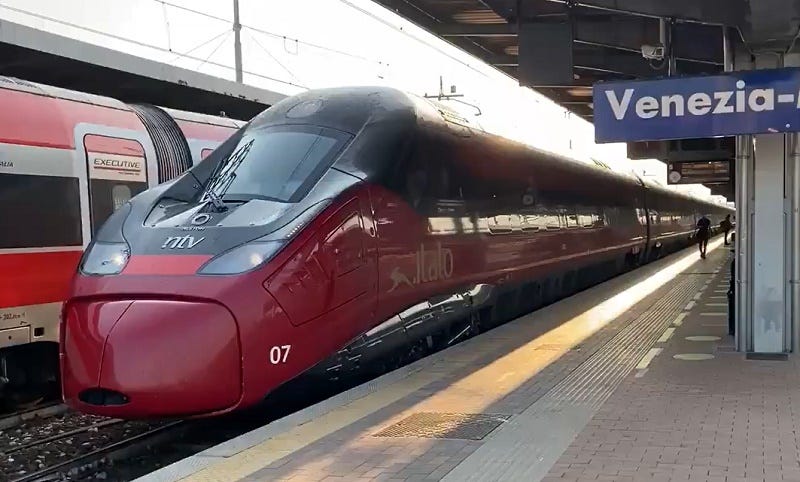
Italo high-speed train. ©AndyBTravels
Differences between Italo and Trenitalia
That said, there are a few small differences that might sway you towards booking with one operator rather than the other.
Trenitalia’s Frecciarossa services run slightly more frequently, and its trains have a café-bar coach where you can buy snacks and drinks, while Italo trains offer vending machines only.
However, if you bring your own food and drinks on board, or travel in first class which includes some snacks and drinks served at your seat, there is again little difference between Italo and Trenitalia.
Although both Italo and Trenitalia offer a premium first class with even more comfortable seats – called Club on Italo trains and Executive on Trenitalia Frecciarossa services – Trenitalia’s Executive Class comes out ahead, thanks to a more spacious seating configuration (1+1 versus 2+1) and superior catering.

A Frecciarossa high-speed train of Trenitalia. ©AndyBTravels
Train connections: where Trenitalia is best!
If you are making a direct journey between some of Italy’s main cities, such as Milan to Rome by train, it makes little difference whether you choose Italo or Trenitalia.
However, if you need to travel to or from a smaller town or a suburban station not served by a high-speed train and require a connection – for example, Lucca to Rome, which involves a regional train from Lucca to Florence and a high-speed train from there to Rome – Trenitalia is the better choice.
This is because you can book your trip from Lucca to Rome as a single ticket with one operator, since Trenitalia is the operator of the regional train from Lucca to Florence and also runs high-speed trains from Florence to Rome.
You could theoretically book separate tickets, taking the Trenitalia regional train from Lucca to Florence and then an Italo train from Florence to Rome, but the main drawback is that you have no protection in case of a delay.
In other words, if your regional train from Lucca to Florence is delayed and you miss your Italo connection, neither operator is obliged to rebook you on a later train.
By contrast, if you book a single Lucca to Rome ticket with Trenitalia and miss your connection between the regional and high-speed trains in Florence, Trenitalia is legally required to put you on the next available train free of charge.
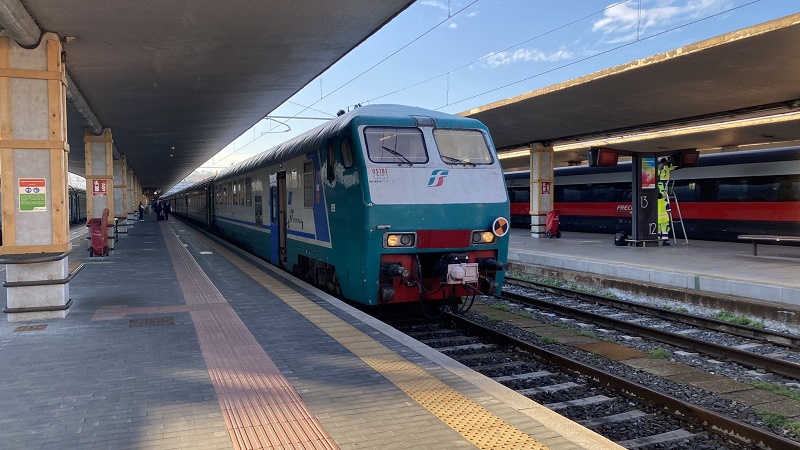
A regional train of Trenitalia at the main railway station of Florence. ©AndyBTravels
Interrail and Eurail
If you are using a Eurail or Interrail Pass to travel around Italy, whether it’s a global pass valid for all of Europe or an Italy rail pass, you can only use it on Trenitalia trains, as Italo trains are not included in the pass network.
Read more about how to book passholder fares for Trenitalia trains here.
Conclusion
Trenitalia, the Italian national railway company, and Italo, a private high-speed operator, are the two main railway companies in Italy.
Although Italo high-speed trains and Trenitalia’s Frecciarossa services are fairly comparable in comfort, speed, and reliability, there are some differences between the two that are worth noting.
These differences are negligible if you are travelling directly between major cities such as Rome, Florence, Milan, and Venice, in which case I suggest choosing whichever company offers the best price or schedule.
However, if your journey requires a connection involving a regional or commuter train, you are usually better off booking your entire trip through Trenitalia, as this allows you to book the whole journey on a single ticket and provides protection if you miss your connection due to a delay.