A Guide to Renfe Trains: All Spanish Train Categories Explained
This short guide shows you all the different train categories operated by Renfe in Spain, and the differences between them.
Travelling by train in Spain with Renfe
Renfe is the Spanish national railway company, and although it is not the only operator of trains in Spain, it does run the vast majority of services across the country.
For a first-time train traveller in Spain, it can be difficult to get to grips with the railway terminology, as Renfe has numerous train categories, all with their own rules regarding reservations and ticketing, as well as different onboard facilities and levels of comfort.
As an avid rail traveller who has actually travelled on every single railway line in Spain for my #AllTheLinesEurope project, let me explain what each train category in Spain actually entails!
All train categories in Spain
Below are all the Renfe train categories you can find in Spain, roughly ranked from the fastest, most premium services to the slowest commuter trains that stop at all stations.
- AVE: Renfe’s most premium high-speed train services
- Euromed: Renfe’s high-speed train service between Barcelona, Valencia, and Alicante
- Alvia: The second-tier high-speed trains operated by Renfe
- Avant: Renfe high-speed trains on short- and mid-distance routes
- Avlo: Renfe’s low-cost high-speed train
- InterCity (IC): Renfe’s standard long-distance trains
- Media Distancia (MD): Renfe’s mid-distance trains
- Regional trains
- Commuter trains (called ‘Cercanías’ in most of Spain, but known as Rodalies in Catalonia)
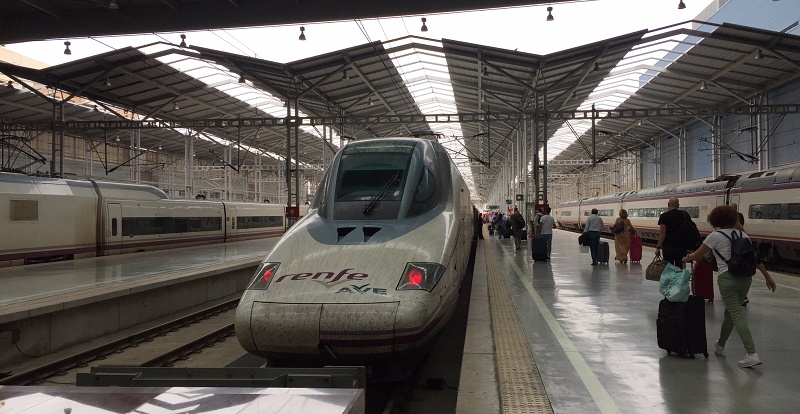
Renfe trains at the railway station of Malaga. ©AndyBTravels
Ticketing and what to expect on board Spanish trains
Renfe denotes first class as ‘Comfort’ and second class as ‘Standard’.
First class is available on most of Renfe’s high-speed services, although Avant trains are second class only.
Básico, Elige and Prémium refer to the different fares you can book your ticket in, with Básico being the cheapest fare, which is non-refundable and non-changeable, while Prémium is the most expensive but also the most flexible fare.
On AVE and Euromed services, the Prémium fare comes with extras such as lounge access (at stations that have a Renfe lounge) and a complimentary meal served at your seat.
Apart from Prémium first class tickets, no food or drinks are included with any other ticket.
Café-bar coaches where you can buy food and drinks can always be found on Renfe’s AVE and Euromed high-speed services, while many (but not all!) Alvia, Avant and Intercity trains will have them as well.
For high-speed and long-distance services, a seat reservation is compulsory and will automatically be included with your ticket.
Many mid-distance trains also require a compulsory seat reservation nowadays.
This means that these trains can sell out, so you are well advised to buy your ticket ahead of time, especially when travelling in high season or around major holidays.
Make sure you also read my article with Spanish train ticket booking tips to secure the best deal!
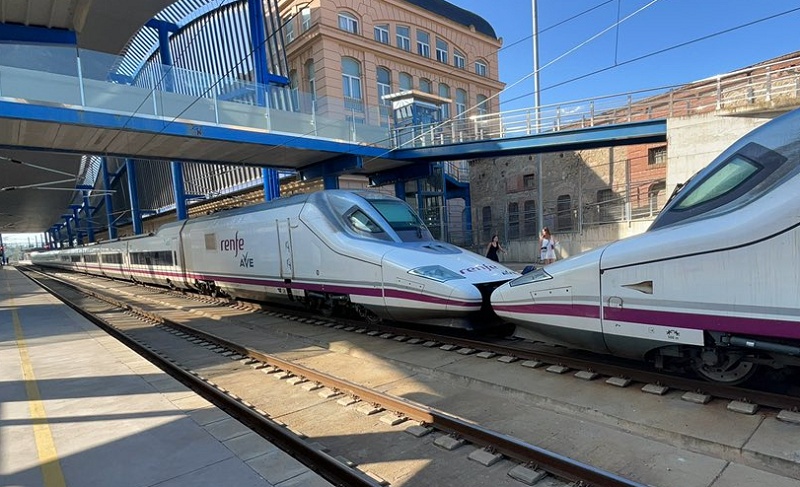
Renfe AVE high-speed train. ©AndyBTravels
Trains used in Spain
One caveat: even though a train service might be better on paper, it doesn’t necessarily mean that it will be better in real life.
The train category doesn’t tell you which type of train is actually used to operate the service.
For example, a Renfe AVE service could be operated by an S100 train (similar to the French TGV), an S103 (similar to the German ICE), or one of the Talgo-built trains (the ubiquitous S102/S112 and the new S106 ‘Avril’).
There can be a wide difference between them in terms of onboard quality.
For example, the Avril is infamous for having a 2+3 seating configuration in second class and a 2+2 seating configuration in first class, while on all the other trains I mentioned you have a much more spacious and comfortable 2+2 configuration in second class and 2+1 in first class.
This means that even though an AVE high-speed train service might in theory be better than an Alvia service, that might not be the case in practice if it is operated by an Avril!
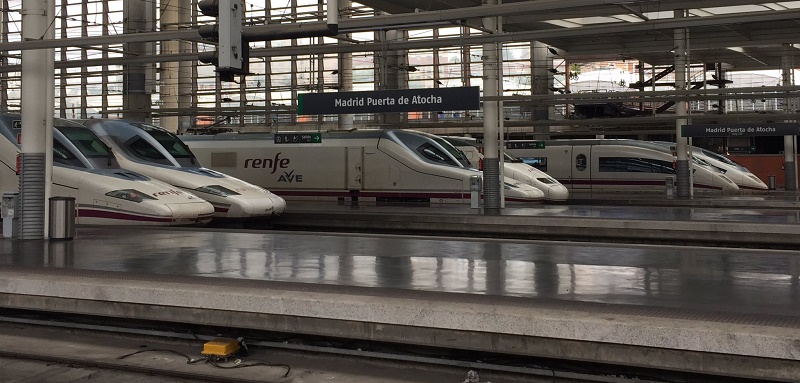
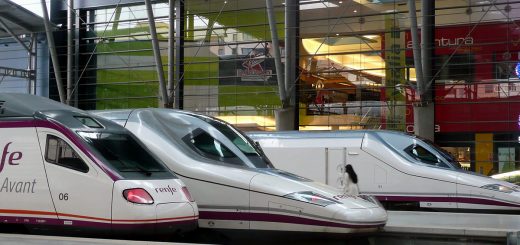
Different Renfe high-speed train types at Madrid Atocha station. ©AndyBTravels
Other railway companies
Don’t forget that Spain has competition on its high-speed railway network, with open-access operators competing with Renfe on many routes.
These are Iryo, which is similar to Renfe’s AVE high-speed trains, and Ouigo España, which runs low-cost high-speed trains similar to Renfe’s Avlo services.
So which of these Spanish railway companies should you choose?
It’s smart to always compare departure times and fares across all operators to see which option works best for your route and date of travel.
On the reliable booking website Omio, you can compare trains from all railway companies in Spain, including all Renfe train categories, in a single search, and then book the best option.
Book your Spanish rail holiday
If organising a train journey across Spain seems a bit too challenging, it is also possible to book a rail holiday to Spain through the highly reputable British rail travel agency Byway, which includes all train tickets, hotels, and protection in case a train is cancelled or you miss a connection.
There are dozens of exciting Spanish rail holidays you can choose from, and they can all be designed and tailored to your needs.
Use the discount code DiscoverByRail75 to get £75 off any rail holiday you book with Byway.