How to Travel From the UK to Spain by Train
Although a train trip from the UK to Spain may seem daunting considering the large distance involved, it’s actually a straightforward journey.
UK to Spain by train
There are multiple rail routes you can take to get from the UK to Spain, and you will likely need to make an overnight stopover somewhere en route.
That means there isn’t really a “best” route, as it depends on your preferred stopover destination and which place in Spain you actually want to travel to!
Below, I’ll explain how you can travel from the UK to Spain by train and where you can book all your tickets.
Step 1: Get to Paris
The first step if you want to travel from the UK to Spain by train is to reach London if you live outside the British capital.
From London, you then take a Eurostar train to Paris, arriving at Gare du Nord (the northern railway station).
If you start your journey early in the morning from London, you can make a same-day connection in Paris onto a mid-afternoon train towards Spain, though if you have to travel from further afield in the UK, you will have to stay overnight in Paris.
Note that there is a station change in Paris, as your onward train will depart from either Paris Montparnasse or Paris Gare de Lyon, depending on which service you take.
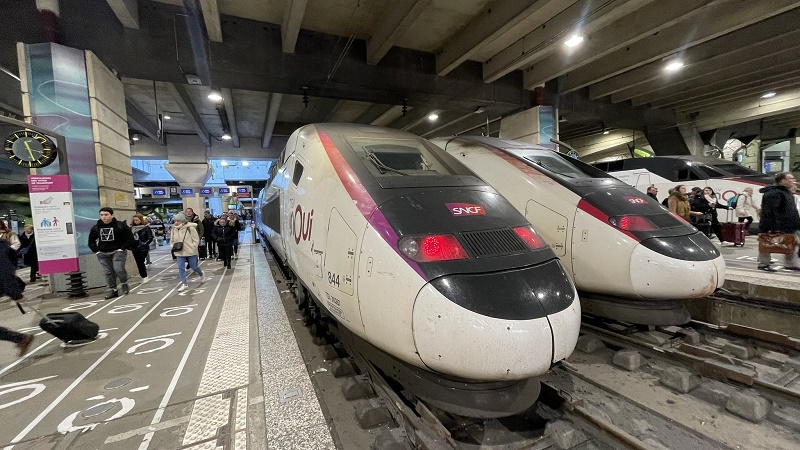
TGV high-speed trains at Paris Montparnasse station. ©AndyBTravels
Step 2: Take a train from Paris to Spain
There are two main railway routes from Paris to Spain: you can either catch a high-speed TGV on the Atlantic high-speed railway corridor to the Franco-Spanish border between Hendaye and Irun, or take a TGV on the south-eastern and Mediterranean corridor towards Barcelona.
The first route is handy for the Basque Country and nearby destinations, while the second is the easiest for Catalonia and most other destinations in Spain, including Madrid.
If you take the first route, you will travel on a TGV high-speed train from Paris (Gare Montparnasse) to the French border station of Hendaye, where you can catch a local train across the border to Irun or San Sebastián in Spain.
Note that if you take this route after January 2027, the high-speed train services from Paris will be extended across the border from Hendaye to Irun, making this route much easier.
The second route involves taking either the early-morning or mid-afternoon Paris–Barcelona TGV high-speed train.
This train departs from Paris Gare de Lyon and arrives at Barcelona Sants.
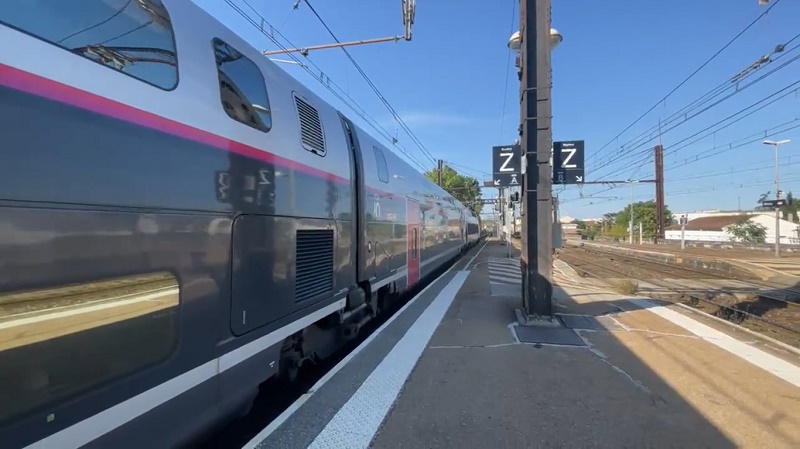
Paris–Barcelona TGV high-speed train at Nîmes. ©AndyBTravels
Step 3: Travel onward in Spain
From Irun, San Sebastián or Barcelona, you can take an onward train to wherever you want to go in Spain!
For example, you can take a high-speed train from Barcelona to Madrid or Barcelona to Valencia.
Or perhaps take the suburban Rodalies train service in Barcelona to visit some of the coastal resorts in Catalonia.
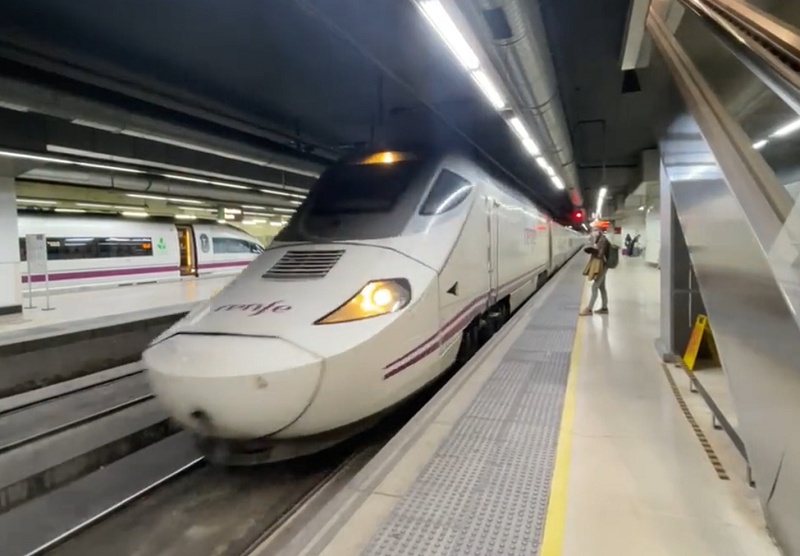
The Euromed train to Valencia and Alicante arrives at Barcelona Sants. ©AndyBTravels
An alternative: Travel via Lille and Nimes
A popular alternative for travelling from the UK to Spain by train is to bypass Paris and avoid the hassle of crossing the French capital by public transport or taxi to get from Gare du Nord to Gare de Lyon.
You can take the Eurostar train from London to Lille and change at the same station onto a TGV train to the south of France, for example, to Nîmes.
Stay overnight in Nîmes, then take the TGV high-speed train to Barcelona the following day.
Buying tickets
Read my Eurostar guide for information on buying Eurostar train tickets.
Tickets for French and Spanish high-speed trains can easily be bought through the reliable booking website Omio.
High-speed trains in France and Spain use dynamic pricing and are generally cheaper if you buy your ticket as far in advance as possible.
It’s generally a good idea to book train tickets in advance, especially for the Paris–Barcelona TGV, as this is a popular service that often gets fully booked.
French and Spanish high-speed trains have compulsory seat reservations, which are automatically included with your ticket.
Local trains, such as the service linking Hendaye with Irun and San Sebastián, have fixed fares and cannot be booked in advance.
For such trains, simply buy your ticket at the station before departure.
For more information, read my article about booking tips for Spanish trains.
Ticketing alternatives
You can also use an Interrail pass to cover your train journey from the UK to Spain.
While Interrail has the advantage of flexibility, you need to check whether it works out cheaper than advance point-to-point fares.
Don’t forget that with Interrail, you still need to pay special passholder reservations to reserve seats on Eurostar and high-speed trains in France and Spain, which adds to the cost.
Alternatively, you can book a fully organised rail holiday to Spain – a great alternative for those who are a bit daunted by all the ticketing options and want professionals to deal with all the arrangements, so they can just sit back and enjoy their train trip to Spain.
Conclusion
There are two main train routes from the UK to Spain, both running via France.
The first option involves taking the Eurostar train to Paris, where you connect onto a high-speed train to the Franco-Spanish border between Hendaye and Irun.
The second option, which is more popular due to its better onward connectivity, also involves travelling by Eurostar to Paris, where you can catch the Paris–Barcelona TGV train.
From Barcelona, it’s easy to travel onwards to other Spanish cities, such as Madrid, Valencia, Seville or Málaga.