Paris to Stuttgart and Munich by High-Speed Train
It is easy to travel by high-speed train from the French capital of Paris to either Stuttgart or Munich in southern Germany.
In this short guide, I’ll tell you everything you need to know about these high-speed train services, including what it’s like on board and how to book tickets.
Paris to Stuttgart by high-speed train
At the time of writing, there are six daily high-speed trains linking Paris Gare de l’Est with Stuttgart Hbf, the main railway station in Stuttgart, the capital of the south-western German state of Baden-Württemberg.
These high-speed trains take just 3 hours and 11 minutes to travel between Paris and Stuttgart.
The first train currently departs in the morning from Paris at 07:53, arriving in Stuttgart at 11:06, with the last train departing at 19:54 and arriving in Stuttgart at 23:04.
Two of these six trains are German ICE high-speed trains, while the other four are French TGV high-speed trains.
Although they offer similar comfort levels (2+1 seating in first class, 2+2 seating in second class), the TGV high-speed trains have a café-bar counter only, while ICE high-speed trains have proper sit-down dining cars where you can get full meals.
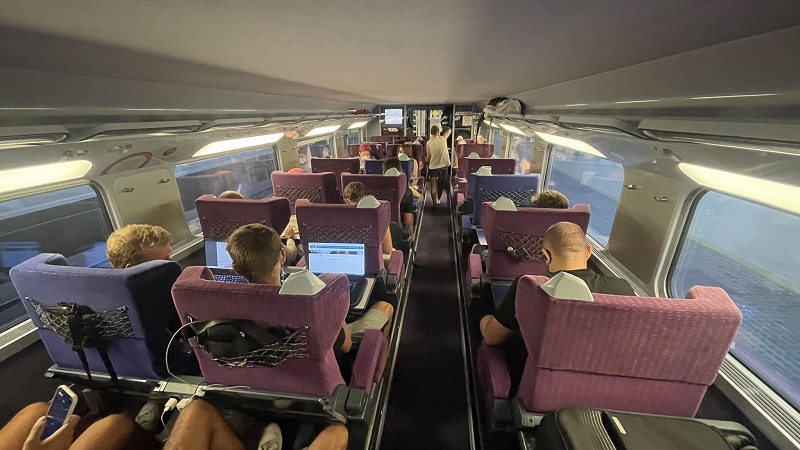
First class seats on the TGV high-speed train. ©AndyBTravels
Paris to Munich by high-speed train
Currently, there is only one daily direct high-speed train between Paris and Munich, taking 5 hours and 41 minutes to complete the journey.
This train departs from Paris Gare de l’Est at 15:55 and arrives at Munich Hbf, the main railway station of the Bavarian capital, at 21:36.
The service is operated by a French TGV high-speed train, which stops en route at Strasbourg, Karlsruhe, Stuttgart, Ulm and Augsburg.
If the departure time of this direct TGV is not convenient, there are more options involving a change of trains in Karlsruhe or Stuttgart.
You can first take a high-speed train from Paris to either Karlsruhe or Stuttgart, and then change onto a German ICE high-speed train to Munich.
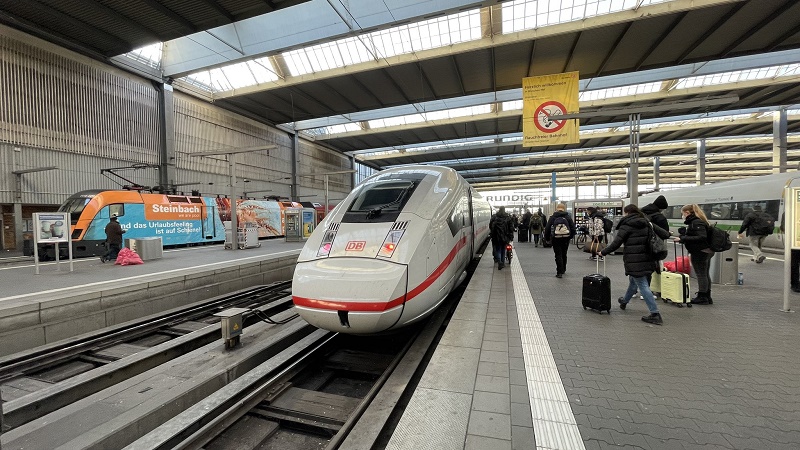
ICE high-speed train at Munich Hbf. ©AndyBTravels
Connection tips
The high-speed train service between Paris, Stuttgart and Munich is also a great option for British train travellers.
Paris Gare du Nord, where Eurostar trains from London arrive, is an easy 10-minute walk from Paris Gare de l’Est, making the connection between the two stations straightforward.
If you plan to make an onward connection in Karlsruhe or Stuttgart, it’s always a good idea to allow enough buffer time to make your connection safely.
This is especially important if you’re connecting onto the last train of the day to your final destination, or onto a night train (such as the Stuttgart–Zagreb, Stuttgart–Budapest or Stuttgart–Venice sleepers).
That said, if a delay to your high-speed train from Paris causes you to miss your onward connection, for example an ICE high-speed train to Munich, you are entitled to take the next available train.
Just remember that any seats you may have reserved on your connecting train won’t automatically be carried over to your new train if you miss your connection and are forced to take a later service.
This is another reason why I would always allow plenty of time for a connection, especially if you’re travelling with your family or as part of a group.
For connections in Stuttgart, it’s worth remembering that Stuttgart Hbf is a terminus station.
If your connection is tight, try to move towards the front of the train around 10 to 15 minutes before arrival to give yourself a better chance of making it.

Stuttgart Hbf, the main railway station in Stuttgart. ©Paliparan
Where to book tickets
Train tickets for travel between France and Germany, including the Paris–Stuttgart and Paris–Munich ICE and TGV high-speed trains, can easily be booked online through the reliable booking platform Omio.
A seat reservation is required on high-speed trains between France and Germany and is automatically included with your ticket.
Remember that high-speed trains in France and Germany have dynamic pricing based on demand, and tickets can sell out, so it’s generally best to book as early as possible.
Use the journey planner below to find the best connection for your travel date.
Using Interrail on high-speed trains between France and Germany
If you’re travelling around Europe with an Interrail pass, you should know that international high-speed trains between France and Germany require a special passholder fare.
Read my article on how to book an Interrail passholder fare for this train.
Remember that a standard seat reservation (such as the ones you can book on the Deutsche Bahn website) is not sufficient for any of the high-speed trains between France and Germany when using Interrail.
If you travel without the correct passholder fare, you may be asked to pay the fare difference on board or even be required to leave the train.
The Interrail passholder fare for high-speed trains between France and Germany currently costs €19 in both 1st and 2nd class.
Conclusion
Multiple ICE and TGV high-speed trains link Paris with Stuttgart and Munich, making them a convenient way to travel from France to southern Germany.
Currently, there are six direct trains each day between Paris and Stuttgart, taking just over 3 hours, and just one daily direct train between Paris and Munich, taking 5 hours and 41 minutes.
More connections to Munich are available by changing trains in Stuttgart.