How to Travel by Train From Venice to Milan
The train is the best way to travel from Venice to Milan, offering a fast, comfortable journey across the heart of Northern Italy.
This guide shows what it is like to travel by train between Venice and Milan, explains how and where to book tickets, and also shares a couple of handy insider tips.
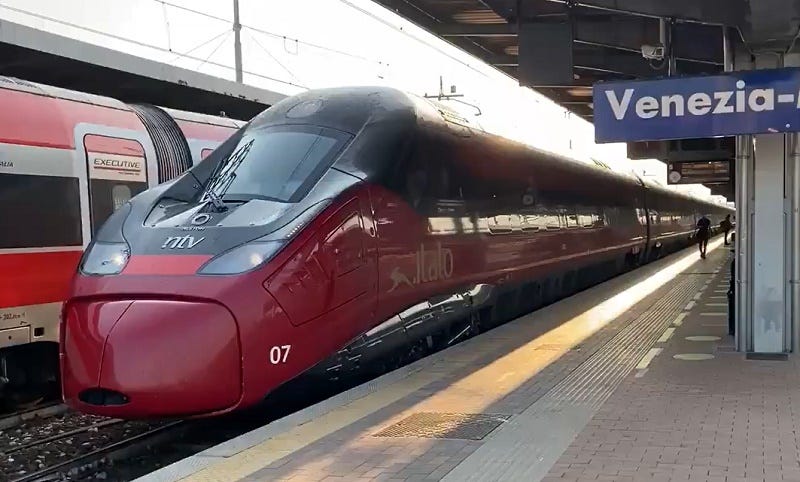
Italo high-speed train at Venezia Mestre. ©AndyBTravels
Venice to Milan by train: the basics
With a travel time of just over two hours, the train is the perfect option for getting from Venice to Milan, or vice versa.
There are two competing railway companies operating on the Venice-Milan route.
One is the state-run Trenitalia, Italy’s national rail operator, while the other is the private high-speed operator Italo.
Both companies run high-speed services on the Venice-Milan route, and whether you choose an Italo train or Trenitalia’s premium Frecciarossa service, you can expect a fast and comfortable journey.
The reliable online booking platform Omio allows you to compare both Italo and Trenitalia trains in a single search, making it easy to find the best option for your journey in terms of price or schedule.
Use the online search tool below to find the best train connection for your date of travel.
Ticketing advice
High-speed trains in Italy are priced according to demand, much like flights, and are generally best booked as far in advance as possible, especially if you are travelling during the high summer season, around national holidays, or at popular times such as Friday evening or Monday morning departures.
That said, if you travel in the low season on less popular days – such as Wednesday or Saturday – you might still be able to find some great last-minute deals.
While Italo exclusively operates high-speed trains, Trenitalia also runs InterCity and regional services, known as Regionale or Regionale Veloce, the latter being a faster regional train.
Although these services are less premium in terms of quality and certainly slower, they can be cheaper if you are a budget traveller looking for the best deal.
This is because, while high-speed trains are priced according to demand, regional trains have a fixed price regardless of when you buy the ticket.
Regional trains can never sell out, as there is no assigned seating and you can simply take any available seat.
By contrast, high-speed and InterCity trains have compulsory seat reservations – automatically included in your ticket – which means these services can sell out.
Venice railway stations
Venice has two main railway stations: Venezia Santa Lucia, located within the historic city on one of its islands, and Venezia Mestre – the modern city on the mainland.
Check which station best suits the location of your hotel and your travel plans before buying your ticket.
Venezia Santa Lucia sits right on the banks of the Grand Canal, and if you start your journey there, you will already be treated to beautiful views of the Venice Lagoon as the train crosses the causeway to Mestre station on the mainland.

Venezia Santa Lucia station. ©Paliparan
Along the route
After the stop in Venezia Mestre, the train journey will continue across the plains of northern Italy, which are rather unremarkable in terms of scenery, though on a clear winter day you might get some glimpses of the Alps on the horizon if you’re seated on the right-hand side of the train.
Most high-speed trains make a few stops en route between Venice and Milan in cities such as Padua, Verona, and Brescia.
If you have time during your trip, these cities are all well worth visiting.
Remember that if you want to make a stopover, you need to book separate tickets – for example, one from Venice to Verona and another from Verona to Milan.
Arriving in Milan
Milano Centrale is the main railway station in Milan and the one most commonly used by trains from Venice.
However, some services use alternative stations in the city.
This is most common for through services that do not terminate in Milan, such as some Venice-Milan-Turin trains, which may call at Milano Porta Garibaldi instead of Centrale.
Again, check which Milan station is most convenient for your hotel or onward travel plans before booking a train.
Both Milano Centrale and Milano Porta Garibaldi offer excellent connections to suburban trains, buses, and the metro.
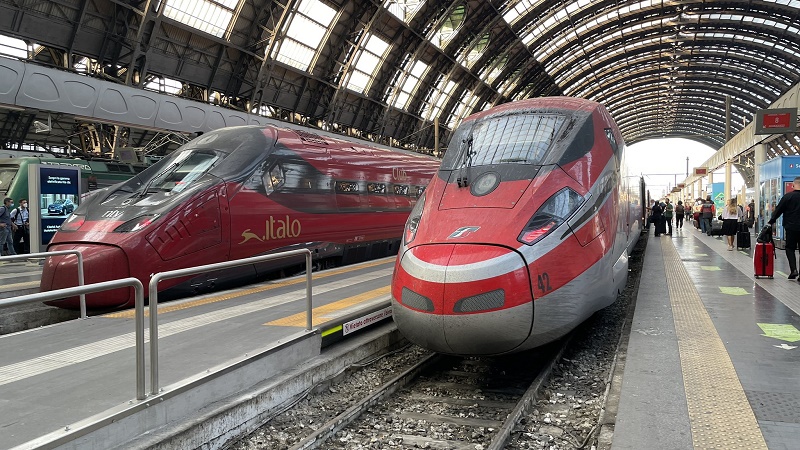
Italo and Trenitalia high-speed trains at Milano Centrale, the central railway station of Milan. ©AndyBTravels
Conclusion
With a fast travel time and dozens of daily departures to choose from, the train is clearly the best way to travel between Venice and Milan.
You can choose between Trenitalia’s Frecciarossa high-speed trains, those of the private operator Italo, or perhaps the slower but cheaper regional trains of Trenitalia.