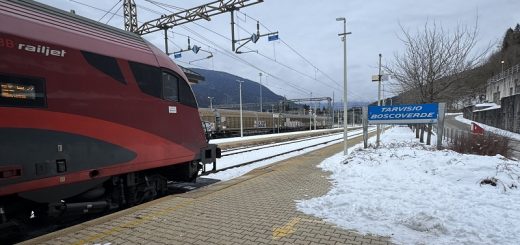
How to Travel From Rome to Florence by Train
Most tourists visiting Italy include both Rome and Florence on their itinerary, as the two beautiful cities are easy to travel between by train.
In this guide, I will tell you everything you need to know about the train service between Rome and Florence and share some insider tips on how to get the most out of your Italian rail trip.
You can use the Omio search tool below to find the best train connection from Rome to Florence, or vice versa, on your chosen travel date.
Different operators
First of all, it is important to note that there are two main long-distance train operators in Italy.
Trenitalia is Italy’s national railway company, while Italo is the competing private high-speed operator.
Both companies run trains between Rome and Florence.
Trenitalia and Italo both have a strong reputation for comfort and reliability, and for most travellers, the deciding factor between the two rail companies will therefore simply the best price and departure time.
When you search for train tickets through Omio, it lists trains operated by both Trenitalia and Italo, making it easy to compare prices and schedules in a single search.
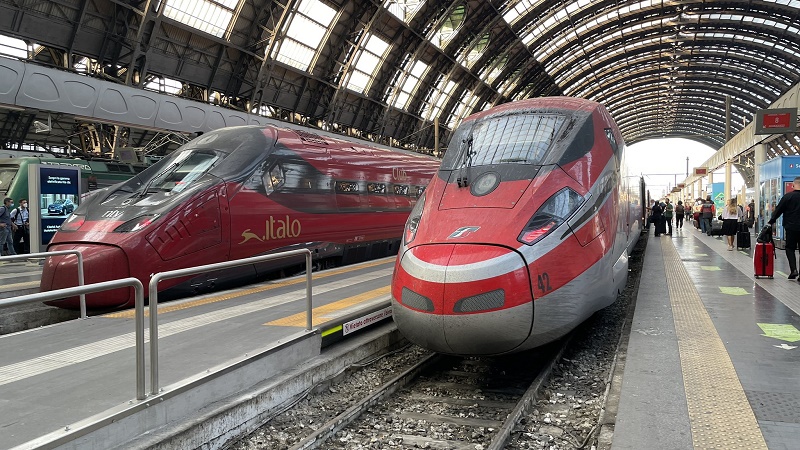
Italo high-speed train (left) and Trenitalia’s Frecciarossa high-speed train (right). ©AndyBTravels
Train types
On the Rome to Florence route, you will come across several different train types.
If you want to travel on a high-speed service, book either a Trenitalia Frecciarossa or any Italo train, as these trains can complete the Rome to Florence journey in as little as 1 hour and 30 minutes.
Frecciarossa is the brand name of Trenitalia’s high-speed service, while Italo exclusively operates high-speed trains, meaning every Italo departure on this route is a high-speed service.
Trenitalia also runs slower and less premium trains between Rome and Florence, which can be worth considering if you do not mind a longer journey and the fare is significantly cheaper.
Among these, InterCity trains are conventional locomotive-hauled long-distance services, while Regionale Veloce and Regionale trains are slower regional services that make many more stops along the way compared to InterCity and high-speed trains.
Needless to say, onboard comfort is highest on high-speed trains, which also offer onboard catering, while regional trains provide the least comfort and fewest facilities.
When booking a high-speed train (whether Trenitalia’s Frecciarossa or Italo) or InterCity train, a seat reservation is included in your ticket.
On regional trains, there is no assigned seating, and you can simply take any available seat.
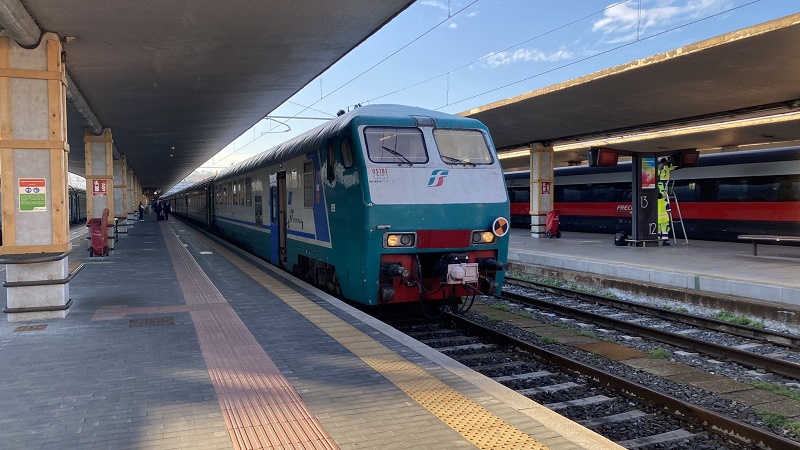
A Florence to Rome ‘Regionale’ train. ©AndyBTravels
Choose the right station
Before booking your train ticket from Rome to Florence, it is wise to consider which station is most convenient.
Both cities have multiple stations, and not all are centrally located.
Roma Termini is the main railway station in Rome, closest to the major sights and well connected to local public transport.
Firenze Santa Maria Novella (often abbreviated as Firenze S.M.N.) is the main station in Florence, just a short walk from the historic centre and attractions such as the Duomo and the Uffizi.
However, some trains – including a few premium high-speed services – use secondary stations in Rome, Florence, or both, such as Roma Tiburtina or Firenze Campo di Marte.
Unless your accommodation happens to be closest to these stations, it is likely much better to use the stations of Roma Termini and Firenze Santa Maria Novella when travelling between Rome and Florence by train.
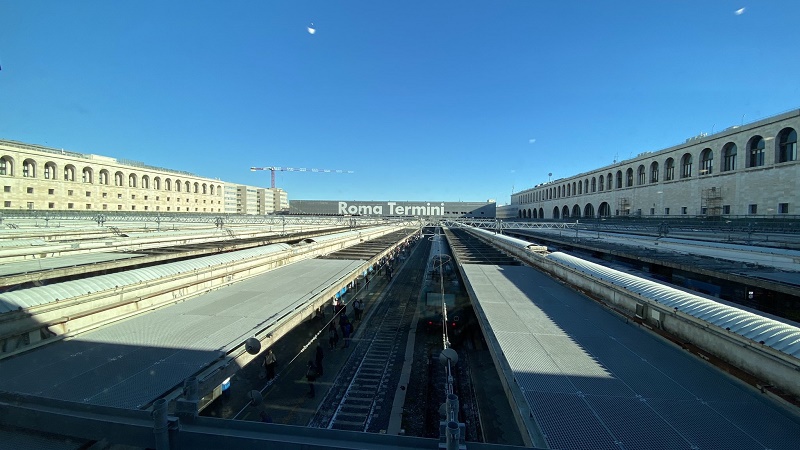
Roma Termini station. ©AndyBTravels
Best time to book
High-speed and InterCity trains in Italy use dynamic pricing, meaning ticket prices vary depending on demand, and are generally cheapest when booked in advance.
Ticket prices are usually higher on popular travel days and times, such as Monday mornings, Friday evenings, or around national holidays.
Similarly, fares tend to be more expensive during the high summer season than in the middle of winter.
As high-speed and InterCity trains require mandatory seat reservations, they can sell out.
It is therefore wise to book your ticket well in advance if you are travelling on popular services or during peak season.
Regional trains in Italy, on the other hand, have fixed prices and never sell out, as there is no assigned seating and you can even travel standing if necessary.
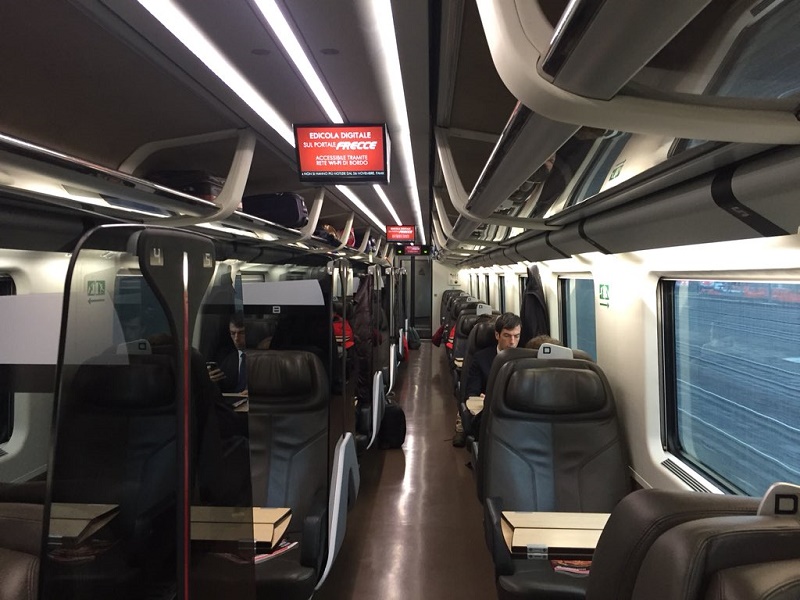
First class seats on a Frecciarossa train. ©AndyBTravels
Using an Interrail or Eurail Pass
If you are using an Interrail or Eurail Pass – whether for unlimited travel across Europe or just an Italian rail pass – you can only use Trenitalia trains, as Italo is not part of the pass network.
To use your rail pass for travel on a Frecciarossa or InterCity train, you will need to make a special passholder reservation – you can read more about this here.
With an Interrail or Eurail Pass, you can freely board any Regionale or Regionale Veloce services – these do not require a reservation.
Boarding your train
Once you have booked your ticket and it is time to travel, simply head to the departure station.
There are no check-in procedures for Italian trains, but it is still wise to arrive at least 30 minutes before departure.
Simply check the departures board to see which platform your train leaves from and make your way there.
When travelling from Rome to Florence, note that Florence is usually just an intermediate stop, so your train may have Milan (most likely) or Venice listed as its final destination on the departure board.
You will need to scan the QR code on your ticket to pass through the gates and access the platform.
Next, simply find the coach where your reserved seat is and board the train.
You can store your bags in the designated baggage racks in the coach or on the overhead luggage racks above your seat.

A Frecciarossa high-speed train. ©AndyBTravels
Conclusion
Taking the train is the best way to travel from Rome to Florence, with high-speed services completing the journey in as little as 90 minutes.
There are dozens of daily departures on this route, with Trenitalia’s Frecciarossa and Italo’s high-speed trains being the fastest and most comfortable options.
Alternatively, you can take a slower InterCity or regional train between Rome and Florence, which can be cheaper if you do not mind the longer travel time.